
by jamesjoyceottawa@gmail.com | Travels
Bloomsday came early to Ottawa this year – not on June 16 but June 13, a Saturday. But in fine Bloomsday tradition, people dressed up like it was June 1904.

In her welcoming remarks, the Chair of the James Joyce Association of Ottawa, Rosemary O’Brien, pointed out that this too was an auspicious date: June 13 happens to be the birthday of W.B. Yeats. The Director of The Ottawa Celtic Choir added that in 1988, the Dublin Millennium Commission proclaimed June 13 as “Molly Malone Day” in Dublin. Apparently a woman with that name had passed away on that date in 1699. It was not known whether she and her parents had been fish mongers, but surely such an occasion called for a song!

That was the queue for a wonderful evening of song and prose, using the works of James Joyce to unpack the rich treasures of musical references found throughout his writing. The audience joined with gusto in the singing of “Molly Malone.” Sharon Labelle then read the “Parable of the Plums” passage from the Aeolus episode of Ulysses. Two elderly ladies climb the Nelson monument where they eat plums, spitting the seeds onto the street below.

Over the course of the evening, the audience was treated to 15 songs and eight readings.
Often there was an obvious connection between the prose and the songs. The choral version of “The Lass of Aughrim,” for example, was followed by a scene from “The Dead” where Greta (Niamh O’Brien) tearfully tells her husband Gabriel Conroy (Dermot Guinnane) about Michael Furey who used to sing that song when they were teenagers. The scene is all the more poignant when you hear the pathos in the song.

Other songs were lifted directly from Joyce’s writing. The lyrics of “I Rush Into Your Arms” – a piece by Irish composer Shaun Davey – were taken from the closing passage of Finnegans Wake. Ellen MacIsaac arranged the piece for a women’s choir and, when augmented by the piano stylings of Sally Robinson, it evoked the River Liffey flowing into the Irish Sea.
“I Dreamt I Slept in Marble Halls” – a piece from an opera composed in 1843 – was quoted at length by Nora Pat Marshall in reading from “Clay”. In the Dubliners story, Maria makes the mistake of singing the first verse twice. Nora Pat said that she hoped that the choir would not make the same mistake. They didn’t.

The choir’s repertoire ranged from melancholy to rambunctious. Thomas Moore’s “The Last Rose of Summer” was paired with the Nausicaa description of Gertie McDowell, read by Mary Comerton. It was followed by a rollicking arrangement for choir of “The Rocky Road to Dublin.”

The programme had something for everyone from the Joyce afficionados to those who didn’t know Joyce’s writing, but were interested in the songs. And for those who could use a quick summary of a long book, Paula McCann soloed “The Ballad of Bloom and Stephen,” a song written by Dublin-based Joycean Andrew Basquille. The song managed to shrink the entire plot of Ulysses into 18 rhyming couplets, which began:
On the sixteenth of June, 1904, the Tower’s the place to be,
With stately, plump Buck Mulligan and the scrotum-tightening sea…”

So on the anniversary of the fish monger who cried, “Alive. Alive-oh!” we paid our tributes to the day that Joyce created in his fertile imagination. Joyce himself was an accomplished singer and he loved music of all kinds, slipping references into his writing as an important part of the rich tapestry that he wove with his words. Fifteen songs and eight readings: it was a wonderful way to mark Bloomsday!


by jamesjoyceottawa@gmail.com | Past Events
As part of the continuing series of readings from the Dubliners short story collection, members of the James Joyce Association of Ottawa presented “Ivy Day in the Committee Room.” The event began with a few rousing songs from “The Band with No Name” — otherwise known as Phil, Larry, Frank, and Geoff.

As master of ceremonies, Niamh O’Brien gave an overview of some of the themes in the story.

The readers included Susanna Doherty, Eileen Cassidy, Dermot Guinane, and Mary Comerton.


The story deals with the 1902 election for Lord Mayor of Dublin. Campaign workers take shelter from the rain by the fireplace in the committee room. The men are brought together in the fellowship of the fireplace and the bottles of stout, and in the admiration they share for “the Chief,” Charles Stuart Parnell.
The reading of the story was followed by the recitation of three poems dealing with current affairs of the past: W.B. Yeats’ “September 1913,” read by Megan Mullin; Seamus Heaney’s “Whatever You Say, Say Nothing,” read by Michael Mullin; and Eavan Boland’s “My Country in Darkness,” read by Rosemary O’Brien.


by jamesjoyceottawa@gmail.com | Past Events
The weather might have been damp at this year’s St. Patrick’s Day Parade, but it certainly did not dampen the spirit of the holiday’s loyal devotees, who took to the Ottawa streets to celebrate Irish culture … and the James Joyce Association of Otttawa was there!


by jamesjoyceottawa@gmail.com | Events, Past Events, Readings
As part of the continuting series of readings from the Dubliners short story collection, members of the James Joyce Association of Ottawa presented, “A Mother,” read by Paula McCann, Sharon Labelle and Niamh O’Brien with commentary by Niamh O”Brien. The Band provided traditional tunes.


by jamesjoyceottawa@gmail.com | Events, Past Events
Just like the Morkan sisters, the JJAO committee, the cast and the crew are all on hand to welcome guests to the second annual presentation of “The Dead,” the final story in Joyce’s Dubliners. Gabriel Conroy arrives with his young daughter, resplendent in her unicorn costume. (NB: This is not what happens in the story!)

The harpist welcomes guests with music.
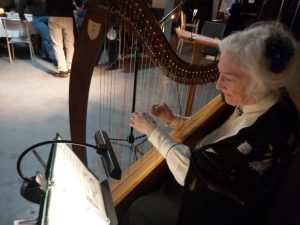
Friends find their tables and catch up on the news and travels of the holiday season. The atmosphere is warm and welcoming.

But soon the tinkle of the harp is joined by the sweet, soaring notes of a young woman singing.

The room hushes.

And when the songs are finished, the narrator steps forward to begin the story.

The Morkans’ guests pair up for the Quadrille dance. Gabriel has been worrying about the after-dinner remarks he composed. Would his speech be too sophisticated for his audience? His dance partner is Miss Ivors. “I have a crow to pluck with you,” she scolds. She berates him about his preference for a continental vacation, rather than travelling to the West of Ireland to get to know his own country better. Isn’t his wife, Gretta, from Connaught, she asks? “West Briton!” she hisses at him as she stalks away.

“We really are all hungry,” observes one of the dancers. “And when we are hungry, we are quarrelsome.” And with that, the guests break away from the story to enjoy the afternoon tea…

…and the sandwiches and desserts.

Following the tea break, Gabriel delivers his speech which concludes with a rousing chorus where everyone stands to sing “For they are jolly gay fellows.” The party begins to wind down. Gabriel waits for his wife, Gretta, at the bottom of the stairs. But she is entranced by the sound of a tenor named Bartell D’Arcy singing “The Lass of Aughrim.”
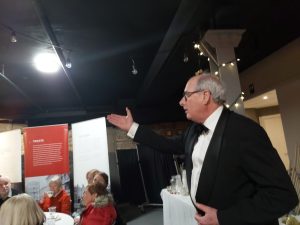
Gabriel and Gretta take a horse-drawn cab through the snowy streets of Dublin back to the hotel room they have booked for the night. The sight of his wife listening to the tenor’s tragic song has lit a passion in Gabriel. He contemplates how much he loves his wife, but when they are alone in the hotel room, she seems distant and preoccupied.

She acknowledges that she has been thinking about a boy named Michael Fury. She was fond of him back when she lived in Galway. This arouses Gabriel’s jealousy and he demands to know whether she is still in love with Michael Furey. He’s dead, she replies – died at age 17.
“And what did he die of so young, Gretta?” asks Gabriel. “Consumption, was it?”
“I think he died for me.”

Through her sobs, Gretta tells the story of Michael Furey and how he used to sing that same song, “The Lass of Aughrim.” His heart was broken when he learned that Gretta had to leave her grandmother’s home to attend school at a distant convent. In the middle of a rainy night, he threw pebbles at her bedroom window and waited for her in the garden in the rain. She pleaded for him to go home before he caught a chill, but when she had only been a week at the convent, she learned he had died.
The passion and sorrow with which she tells Michael Furey’s story precipitates a riot of emotion in Gabriel. “Generous tears filled his eyes. He had never felt that way himself towards any woman, but he knew such a feeling must be love.”
While she sleeps, he broods on how shallow his understanding of his wife has been – how absent of passion has been his own life. And as the snow continues to fall beyond the window, he contemplates how enduring are the links that continue to tie the lives of the living with the legacies of the dead.

Appearing in “The Dead” were: Dermot Guinnane as Gabriel Conroy; Niamh O’Brien as Gretta Conroy; Phil O’Brien and Eileen Cassidy as Narrators; Ciara Julia Hall as Miss Ivors; Aisling O’Brien, Eileen Cassidy, Rosemary O’Brien, Nora Pat Marshall, and Paula McCann as dancers; Geoff White as Bartell D’Arcy; Ciara Julia Hall singer; Nora Pat Marshall harpist; Frank Cassidy whistle.
